Below is the current errata list for this textbook. These errata will be corrected in the next edition.
Nov 2025
Page 175 – Adding or Subtracting Weight (Ballast)
In the worked example for adding ballast to the nose compartment, replace the existing figures with the following:
Present ZFW: 2610 kg
Present moment: 702 index units
Present C of G: 2690 mm
Required C of G: 2680 mm
Required shift: 10 mm
Nose compartment arm: 500 mm
The minimum ballast required is:
2610 × 10 ÷ (2680 – 500) = 12 kg
The resulting Zero Fuel Weight is therefore:
2610 + 12 = 2622 kg
This remains below the maximum allowable ZFW of 2630 kg.
Additional note: The same flow chart may be used for either adding or subtracting weight. Subtracting weight is mathematically equivalent to adding a negative weight.
Page 202 – Exercise 5.7 Worked Answer
The fuel and maximum take-off weight calculation in this worked answer requires correction.
The minimum fuel at take-off should be:
147 kg
The maximum take-off weight at Roma is therefore the least of:
- Take-off limit: 2950 kg
- Landing limit + trip fuel burn-off: 2796 kg
- Zero Fuel Weight limit + fuel: 2630 + 147 = 2777 kg
Therefore:
Maximum take-off weight = 2777 kg
The corrected payload calculation is:
MTOW: 2777 kg
Fuel at take-off: 147 kg
Zero Fuel Weight: 2630 kg
Empty aircraft + pilot: 2062 kg
Payload: 568 kg
Passengers: 308 kg
Maximum cargo: 260 kg
Therefore, the final answer remains:
You may load 260 kg of cargo at Roma.
7.12.2023
Page 89. The solution given at the bottom of the page, Last three lines. ‘155’ should be ‘165’. The answer should be 150 minutes.
24.11.2023
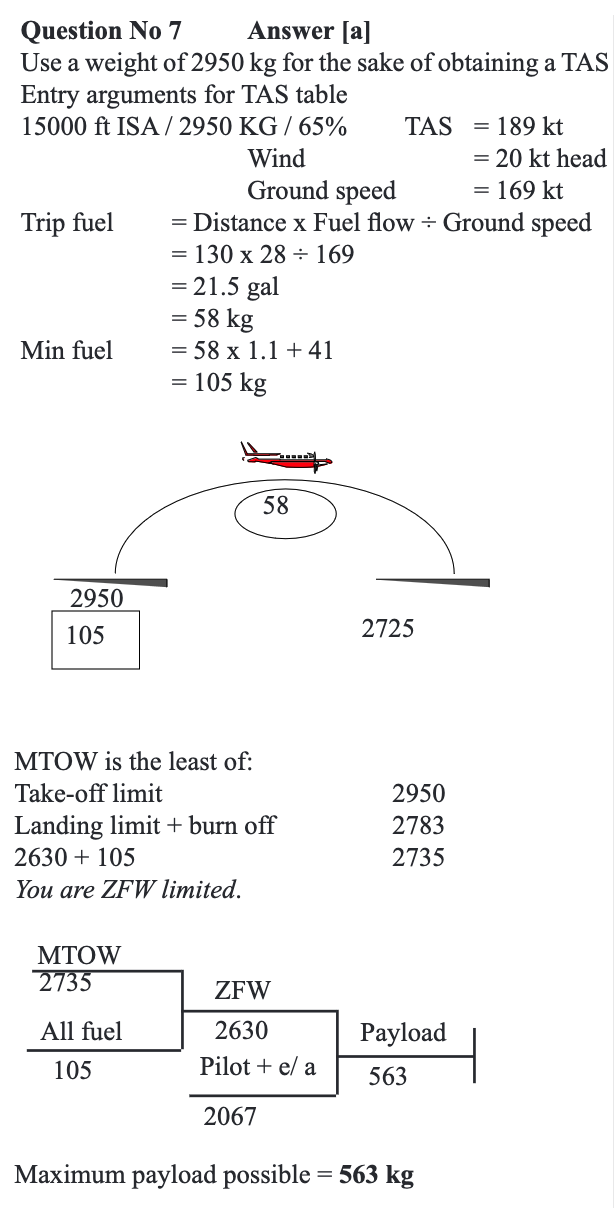
Answer to Question 7 Final Test Page 250 has been replaced..Question 7 Page 250
Page 241 Question 38. The answer choice C is now 4.14% The correct answer remains C.
23.11.2023
Page 228 Question14. and Final Test Question 7 did not specify whether the flight was private or air transport. In both cases, the flight is an air transport flight.
22.06.2023
Page 39 Exercise 3.1. Question 2 There is a typo in the answer choices. (c) should be 1080, not 1180. The correct answer is (c) 1080.
08.02.2023
Changes to contingency fuel requirement since the new CASRs have come into force. Under the ‘old’ rules, contingency fuel was required for both the trip fuel and the destination alternate fuel. Part 135 07.02 now defines trip fuel and destination alternate fuel as separate, and, for airtransport flights, the contingency fuel allowance applies only to trip fuel and not to alternate fuel.
18.10.2022
Page 52 top. Delete reference to slope above 1%. That old CAO is no longer in force. Reference to ERSA is now AIP GEN 2.6.
21.02.2022
There are a couple of questions in the back of the book that refer to DECLARED DENSITY ALTITUDE. Please ignore these questions. Declared Density Charts no longer exist. They were removed in the Dec 2nd 2021 changes to the CASA legislation.
18.02.2022
Page 145 STEP 2 The fuel required at take-off should be 182 x 1.1 + 41 = 241.2kg. However, it doesn’t change the final answer.
11.02.2022
Page 137 and Page 195. The final reserve fuel was incorrect. Please find replacement pages.Page 137 and 195
06.12.2021
LATE CHANGES TO SOME OF THE EXAMPLES IN THE PERFORMANCE STUDY GUIDE.
(Go to our home page and click on the orange tag under ‘BOOKS’).  Performance_replacement_pages.pdf
06.12.2021
Page 123 ANOTHER EXAMPLE OF PNR/ETP CACLULATIONS. Change ‘You are planning an air transport flgiht’ to ‘You are planning a private flight”.
06.12.2021
The introduction of the new CASA regulations format has had very little effect on the content of the Performance Study Guide. For those students who may still have the ‘old’ version (pre December 2021), the link below contains the references to the Part 91 MOS that is now applicable to the Performance Study Guide. PERFORMANCE_ERRATA.pdf
18.08.2021
Page 248. Answer to Final Test Question No 33. The graph shows 150kg but the tag shows 180kg. That should be 150kg. The correct answer us 150kg (a) as given in the Question text on page 235.
01.07.2021
Page 106 Line above EXERCISE 4.17. ‘say 95’ should be ‘say 99,
27.01.2021
Page 261 Question 7 The ZFW calculation is using the wrong trip fuel weight 108kg now reads 105kg
08.09.2020
Page 5 CAAP 92-1(0) now reads CAAP 92-1(1)
Page 225 AIP ENR 1.1 para 4.1.2 now reads para 4.2.1
Page 226 AIP ENR 1.1 para 4.1.2.1 now reads para 4.2.1(d)
Page 226 AIP ENR 1.10 para 2.11(c) now reads para 2.13(c)
Pages 228 & 229 CAAP 43-1(0) now reads CAAP 43-1 v2.0
Page 230 CAAP 42B-1(0) now reads CAAP 42B-1 (1.1)
17.04.2020
Page 125 Question 8. Change the wind given to 070°T at 10kt.
03.03.2020
Since the intoduction of ‘typed -in’ answers in the CASA Performance exam, a much higher degree of accuracy is required for all calculations. The CPL Performance book is being updated to include examples of this requirement including ETP and PNR calculations. A summary of the new material may be downloaded from here. ETP PNR download .pdf
14.11.2019
Page 129. Answers to Exercise 4.18 Question 6. The last line of the working should read 11 gals @ 17.2gh not 8 gals. The answer given is correct though.
03.11.2019
Page 128 Question 10 answer. Should be (c) and has now been changed to 25.3 gallons. The 4 gallons holding fuel was omitted in the original answer,